
Elevating Interactive Motion Architecture
Data binding keys on timelines in Rive represents a significant advancement in reactive design systems and runtime asset generation. Traditionally, keyframing relies on static numerical coordinates or fixed color values defined directly within an animation tool. While effective for isolated motion, static keyframing creates severe bottlenecks when assets must adapt dynamically to external data, real-time user input, or changing runtime environments. By allowing motion designers to bind timeline keyframe values directly to dynamic View Model properties, Rive bridges the gap between complex vector animation and flexible software data structures.
Core Mechanics of Timeline Key Data Binding
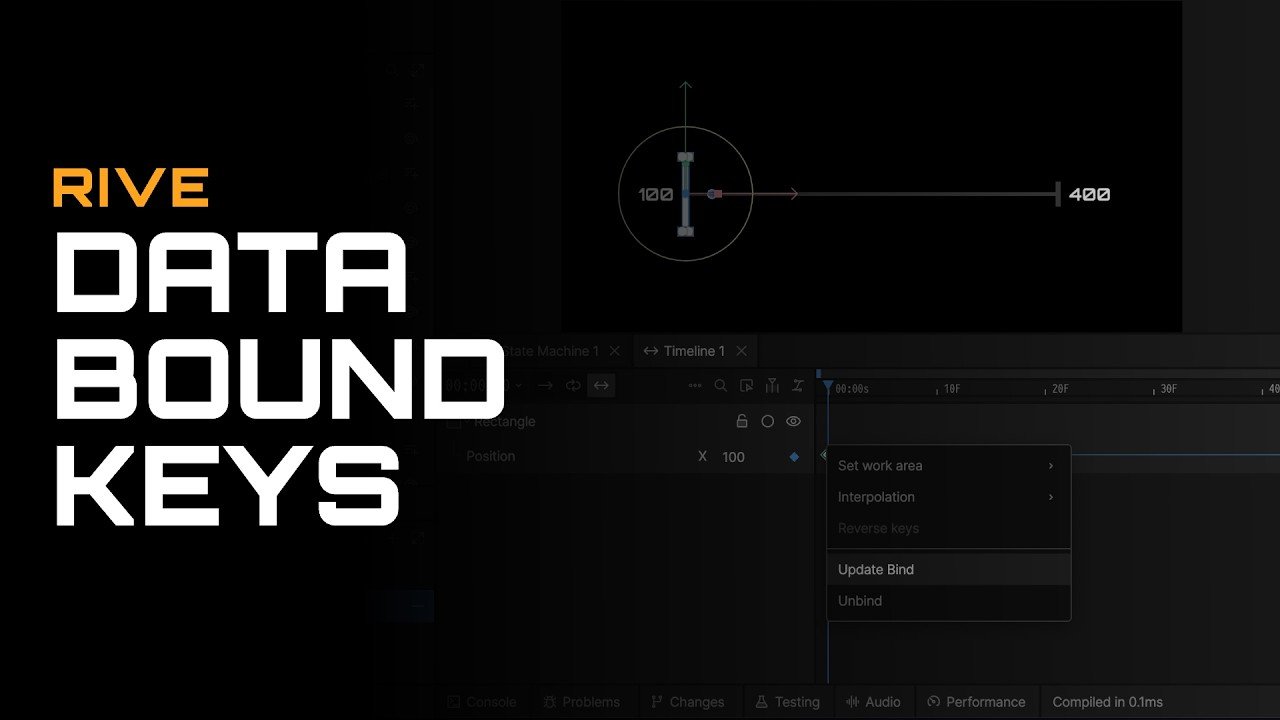
At its core, binding a timeline key to a data source decouples the structure of an animation from its target destination values. Instead of keyframing an object to move from a fixed coordinate of 0px to 400px, a designer can attach the terminal keyframe directly to a dynamic property within a View Model, such as a variable named MaxX. During runtime execution, the state machine evaluates the current value stored in MaxX and calculates the interpolation path on the fly.
This approach preserves all design control over motion curves, cubic bezier handles, duration, and easing functions, while leaving the final visual targets flexible. Whether the destination coordinate is 200px, 400px, or modified dynamically via an API response during runtime playback, the animation smoothly interpolates toward the latest value without requiring multiple manual timeline variations or complex custom code overlays.
Key Technical Implementations Featured in the Tutorial
The workflow demonstrated by Rive’s team illustrates three practical applications across different UI and graphical components:
- Dynamic Spatial Interpolation By attaching numeric properties like MinX and MaxX to individual keyframes on a shape’s position property, an asset can ping-pong or translate across variable spatial bounds. The timeline handles the interpolation mechanics, while the underlying View Model dictates the positional constraints dynamically.
- Data-Driven Data Visualizations Building dynamic UI elements such as progress bars, stamina meters, or percentage-based bar charts becomes straightforward when utilizing responsive layouts combined with data-bound keyframes. By setting a nested layout container to a fixed percentage scale and keyframing its fill width or height from 0% to a target variable Value, the chart animates to match incoming numerical data. This eliminates the need to manually compute asset scale factors outside the runtime engine.
- Global Design System Color Transitions Integrating Global View Models with state machine timeline keys allows full color themes, such as primary brand colors and active hover states, to be applied dynamically across reusable UI components like buttons. When a timeline keyframe for a shape’s fill property is bound to a global color variable, changing the central design system palette instantly updates all associated animation timelines across the entire project file.
Strategic Advantages for Designers and Developers
- Reduced Asset Duplication: Eliminates the need to construct repetitive timeline states for minor numerical variations or color updates.
- Seamless Design System Alignment: Centralizes visual tokens like colors, offsets, and scales in Global View Models that feed directly into keyframed state transitions.
- Efficient Engine Overhead: Shifts calculation responsibilities to the Rive runtime, allowing smooth, continuous vector interpolation driven by lightweight data inputs.
- Cross-Platform Scalability: Prepares complex vector graphics for live web, mobile, and game engine integrations where state variables change asynchronously.
Mastering the integration of data binding keys on timelines unlocks new levels of efficiency for motion designers and interactive developers. By converting static animation targets into dynamic, data-driven properties, you ensure that every asset across your Rive project remains flexible, reactive, and aligned with modern software design requirements.